May 16, 2026 • Dale Kosmicki • 10 min reading time • Prices verified May 24, 2026
Pneumatic Die Grinders for the Production Shop: CFM Requirements, RPM Ratings, and Why Ingersoll Rand Still Sets the Bar
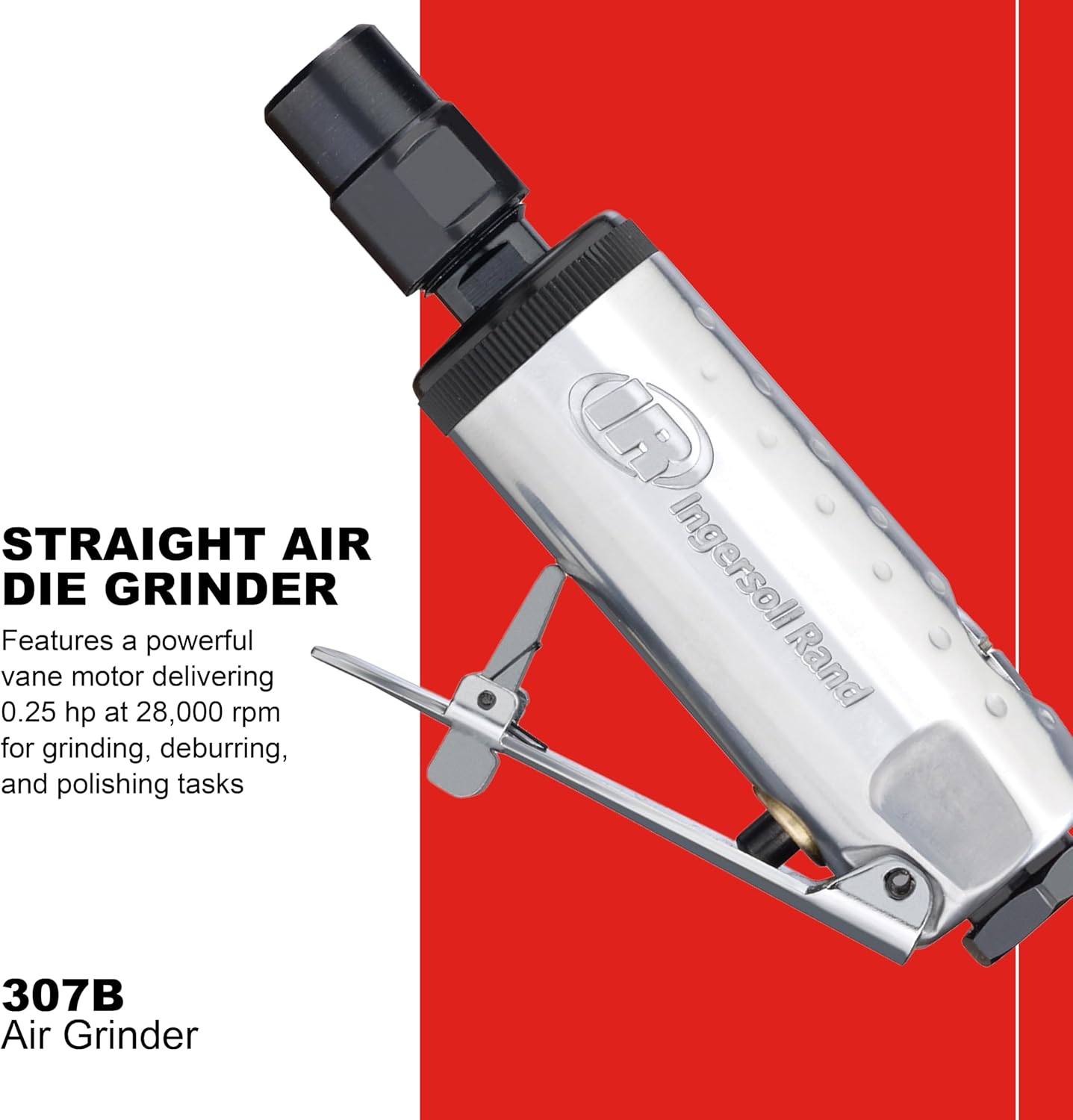
A die grinder is a handheld rotary tool — picture a small, pencil-shaped power tool — that spins a cutting or grinding bit at very high speed. The pneumatic version (pneumatic just means air-powered) runs off a shop’s compressed air supply instead of electricity. That distinction matters: in a busy metal fab shop or foundry, an air-powered grinder is lighter, runs cooler, and doesn’t spark from a motor winding the way an electric tool can. The trade-off is that it puts real demand on your compressor. Get the airflow math wrong, and every grinder in the bay loses speed under load, your finish quality drops, and your operators blame the tool when the real problem is the plumbing. This guide will walk you through how to spec a pneumatic die grinder correctly — CFM requirements, free speed versus working RPM, duty cycle, and why certain brands have dominated production floors for decades — so you can make a confident purchase decision and not repeat it six months later.
| EDITOR'S PICKIngersoll Rand 5102MAX Air Die… | Mid-tierChicago Pneumatic CP872 - Air D… | Budget pickIngersoll Rand 3101G Edge Serie… | |
|---|---|---|---|
| Motor power | 0.4 HP | 0.63 HP | — |
| RPM | 20,000 | — | — |
| Type | Right angle | Straight | Right angle |
| Collet size | — | 1/4" (6mm) | 1/4" |
| Spindle lock | ✓ | — | — |
| Weight | Lightweight | — | Lightweight |
| Price | $129.99 | $84.00 | $59.99 |
| See on Amazon → | See on Amazon → | See on Amazon → |
The Airflow Math Nobody Puts on the Box
The number printed on a grinder’s spec sheet is free speed — the RPM the tool reaches spinning in open air with no load. Under actual cutting load, an air motor loses speed. How much it loses depends on one thing above all others: whether it’s getting the CFM (cubic feet per minute of airflow) it needs at the correct inlet pressure, almost always 90 PSI.
Most 1/4-inch straight die grinders list somewhere between 4 and 6 CFM at 90 PSI. That sounds modest. But multiply it across a crew:
By the numbers:
- 4 grinders × 5 CFM each = 20 CFM continuous demand
- Add 25% for line losses in a typical 3/4-inch header = 25 CFM from your compressor
- Most 5 HP shop compressors deliver 15–18 CFM — meaning a four-station setup with undersized iron will starve every tool simultaneously
If your compressor’s output CFM (not its tank size — the recovery CFM) can’t meet simultaneous demand, your operators are grinding on a starved motor. Free speed on the tag might read 25,000 RPM; working speed under load in a starved line might drop to 16,000 RPM. That’s not just slower — it’s dangerous. Wheel manufacturers rate their products for a maximum operating speed. When an operator presses harder to compensate for lost speed, they create heat and lateral stress that an underpowered motor can’t resist. OSHA 1910.215 and ANSI B7.1 — Safety Requirements for the Use, Care, and Protection of Abrasive Wheels, published by the American National Standards Institute (ansi.org) — both tie abrasive wheel safety directly to operating within rated speed, so this isn’t just a performance issue, it’s a compliance issue.
Rule of thumb: Size your air supply for peak simultaneous demand, not average demand. If you’re outfitting a four-grinder weld-prep station, you want a compressor spec sheet that shows at least 30 CFM of delivery at 90 PSI before you buy a single tool.
RPM Ratings: What the Numbers Actually Mean for Your Application
Die grinders come in a few speed ranges, and the right one depends on what you’re running — not just what sounds impressive.
20,000–25,000 RPM is the standard range for 1/4-inch collet die grinders running carbide burrs, mounted points, or small flap wheels. This is the workhorse range for weld-bead removal, port work, deburring castings, and die finishing. The majority of production shop die grinders live here.
30,000 RPM and above (common in 1/8-inch collet tools) is for very small rotary files and precision die work. Surface speed at the cutting edge is what matters for chip formation — a 30,000 RPM tool running a 1/8-inch carbide burr has lower surface speed than a 20,000 RPM tool running a 1/4-inch burr. Know your accessory diameter, not just the RPM number.
12,000–18,000 RPM tools are sometimes called “extended die grinders” or right-angle die grinders. Lower speed, higher torque — better for surface conditioning discs, larger mounted wheels, or applications where a 25,000 RPM tool would burn a finish.
For general production weld prep on carbon steel and stainless, a 20,000–22,000 RPM straight die grinder with a 1/4-inch collet is the right starting spec. Coverage in The Fabricator consistently reinforces this range as the practical starting point for weld-finishing operations before selecting a more specialized tool. If your shop also does aluminum casting cleanup or precision mold work, you’ll want a second tool in the 25,000–30,000 RPM range.
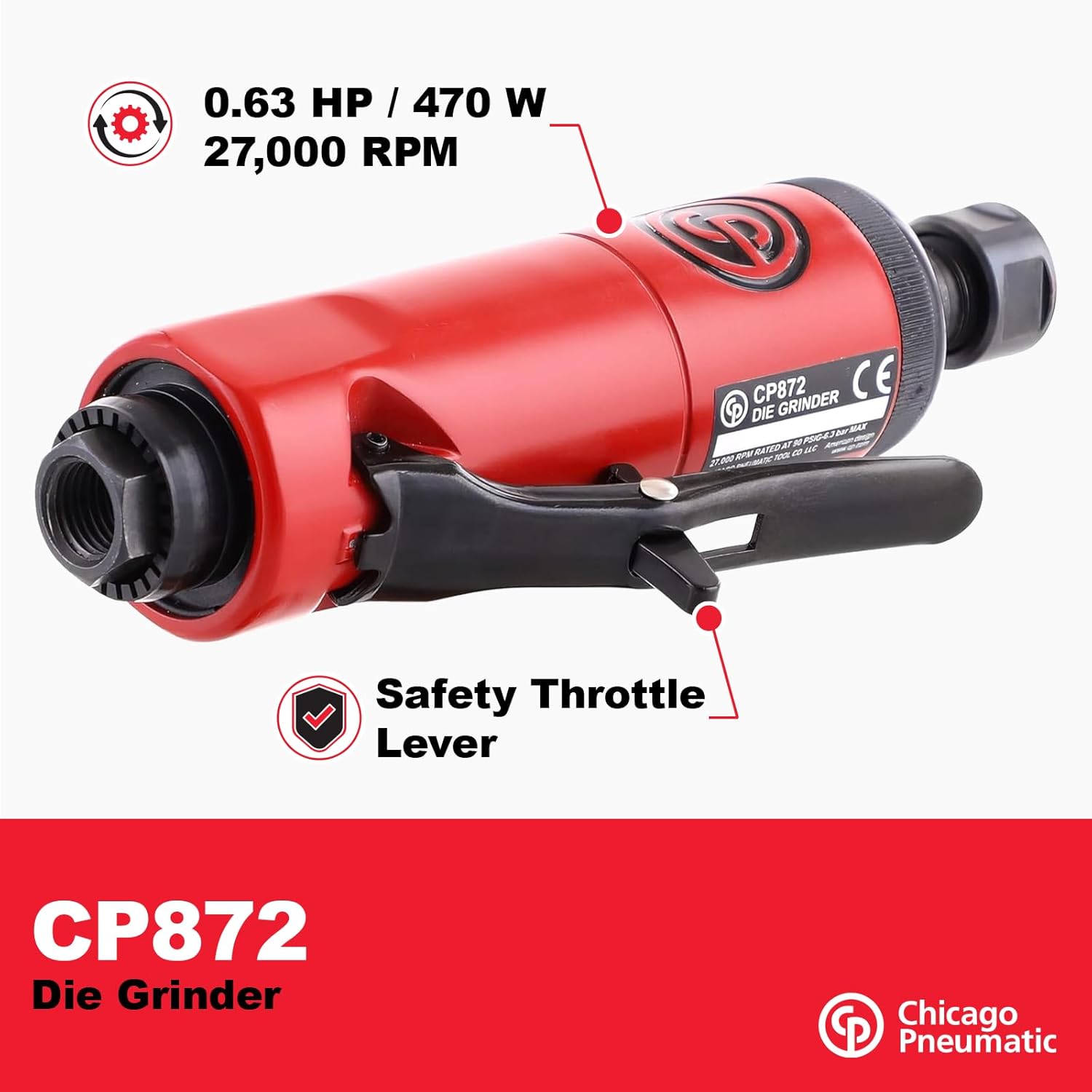
Chicago
$84.00
In stock on Amazon
Check price on AmazonFor everyday weld-bead grinding and deburring, a mid-RPM straight die grinder with a 1/4-inch collet and a 4–5 CFM rating is the right call for most production floors.
Chicago
$84.00
In stock on Amazon
Check price on AmazonWhy Ingersoll Rand Still Sets the Bar — and Where the Challengers Land
Ask anyone who’s been running an air-tool maintenance program for more than a decade which die grinder name shows up least often in the repair bin, and Ingersoll Rand comes up consistently. The reason isn’t marketing. It’s internal tolerances.
Ingersoll Rand’s production die grinders use a vane motor design where the rotor-to-housing clearance is held tight enough that the tools maintain working speed under load better than most of the field. The company also publishes working torque curves — not just free speed — in their air tool product documentation, which lets a buyer predict performance under load rather than guessing. For a production shop where tool downtime is real money, that documentation alone is worth the price premium over a no-name import. Buyers can request full specifications directly from Ingersoll Rand’s industrial distribution channel or review the printed product data sheets available through authorized dealers.
That said, “Ingersoll Rand sets the bar” doesn’t mean it’s the only answer.
Dynabrade has carved out a strong position in surface finishing and aerospace applications, particularly with their inline grinders designed for operator ergonomics over long shifts. If your operators are running six-hour finishing cycles on stainless fabrications, Dynabrade’s vibration-dampened handles and quieter exhaust routing are worth the premium. Their CFM specs tend to be honest — the tools actually deliver rated speed at stated CFM, which isn’t universal in this category.
Chicago Pneumatic occupies the honest middle ground. Their CP-series die grinders are widely stocked at industrial distributors, parts availability is excellent, and their price-to-durability ratio is strong for shops that need to outfit a crew of six without breaking the tool budget. They’re not as tight-tolerance as Ingersoll Rand, but for a shop running one or two shifts on carbon steel work, they hold up well.
Harbor Freight / generic import tools deserve an honest mention: for occasional use — one operator, one deburring station, intermittent work — the budget tier is fine. The vane motors wear faster, the seals don’t last as long, and the CFM draw is sometimes underpublished (meaning the tool actually drinks more air than spec’d). But if the application is light and the volume is low, you’re not leaving much value on the table.
Chicago
$84.00
In stock on Amazon
Check price on AmazonFor a production shop with multiple operators running daily, the professional tier — Ingersoll Rand or equivalent — is the right call. The uptime math almost always justifies the price delta within a year.
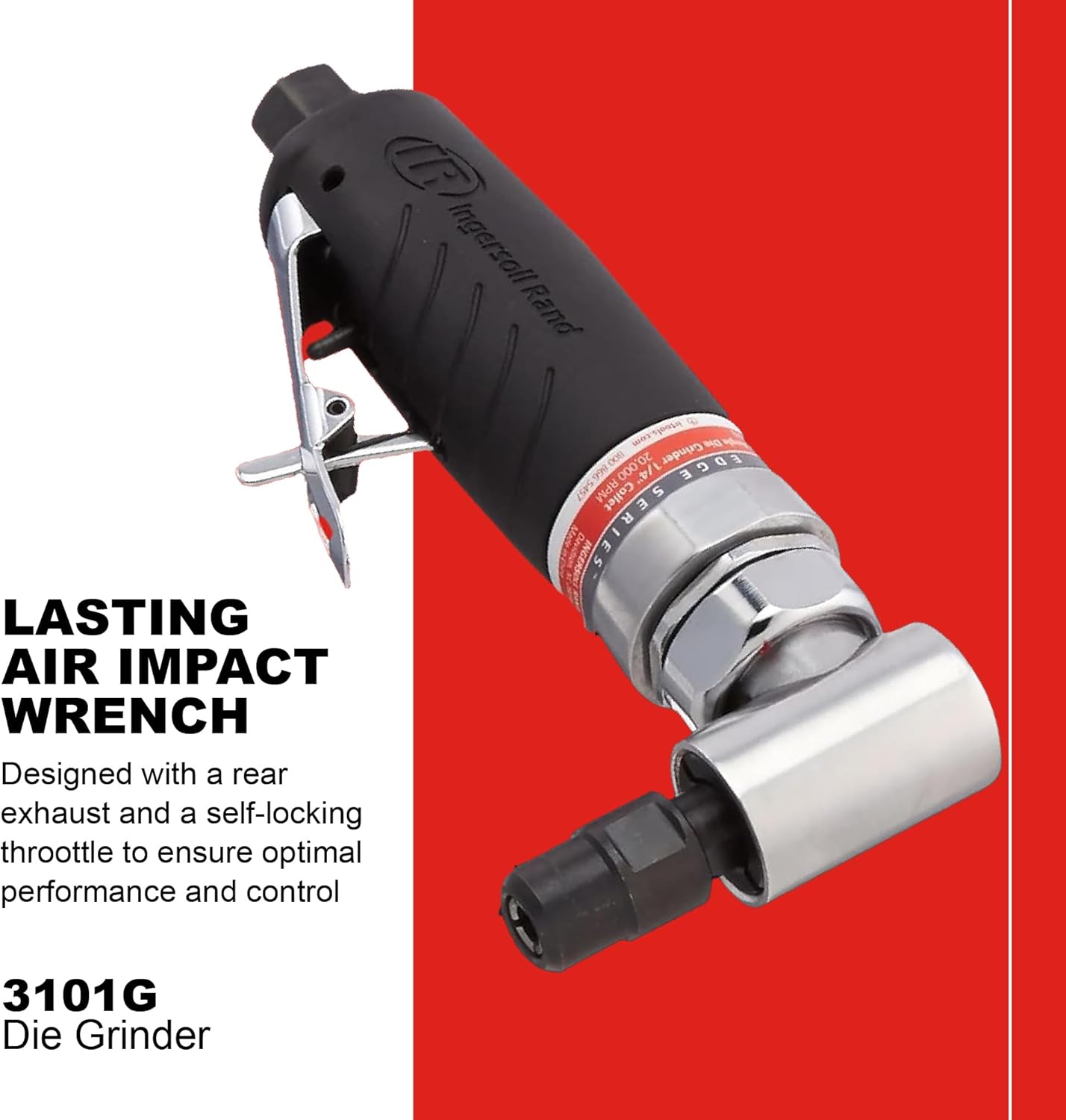
Ingersoll
$59.99
In stock on Amazon
Check price on AmazonFor a single-station occasional deburring application, the budget-tier option gets the job done. Just make sure your compressor can meet its actual CFM draw before you install it in the line.
Duty Cycle, Throttle Type, and the Details That Separate Production Tools from Maintenance Tools
Two features separate a die grinder built for production use from one built for maintenance:
Throttle type. Most die grinders use a lever throttle — squeeze to run, release to stop. That’s correct for abrasive work, where OSHA 1910.215 and ANSI B7.1 — Safety Requirements for the Use, Care, and Protection of Abrasive Wheels (American National Standards Institute, ansi.org) — require the tool to return to idle if the operator loses grip. Some tools add a lock-on trigger for sustained runs. Lock-on is acceptable for rotary file work on fixtures, but should never be used with mounted abrasive wheels — it’s a guard issue and a compliance issue simultaneously. Check your tooling type before specifying lock-on models.
Motor rebuild interval. A quality production die grinder should have a published or dealer-quoted vane rebuild interval. Ingersoll Rand tools typically cite 1,000+ hours before vane replacement on properly lubricated units, as noted in Ingersoll Rand’s air tool product maintenance documentation. Budget tools often don’t publish this because the answer isn’t favorable. For a shop running three shifts, 1,000 hours of tool life is roughly five to six months per unit. Know your consumption before you buy on price alone.
In-line lubrication. Pneumatic air motors depend on oil mist in the air supply to lubricate vanes and bearings. If your shop doesn’t have an in-line oiler on the air header — or if operators rely on manual oiling — your tool life will be significantly shorter than rated. An automatic in-line oiler costs $25–$60 and extends die grinder life by a multiple. It belongs in the math before you spec the tools, not after the first motor fails. These units are a standard accessory category at industrial supply houses; when sourcing alongside any die grinder procurement, search the pneumatic tool accessories category at your preferred industrial distributor for inline oiler options compatible with your header size and flow rating.
Chicago
$84.00
In stock on Amazon
Check price on AmazonIf budget is the primary constraint, pair a mid-tier die grinder with a quality in-line oiler and proper CFM sizing. You’ll get more usable life than spending the same money on a premium tool running on a starved, dry air line.
Building a Comparison Frame: How to Evaluate Any Die Grinder You’re Quoting
Before you sign off on a purchase — whether it’s two tools or twenty — run every candidate through this short filter:
| Evaluation Factor | What to Ask | Minimum for Production |
|---|---|---|
| CFM at 90 PSI | Published spec, not estimated | ≤ 6 CFM per tool at rated speed |
| Free Speed RPM | Matches your accessory rating | Within 20% of accessory max RPM |
| Collet Size | 1/4” for production; 1/8” for precision | Matches your consumable inventory |
| Throttle Type | Lever vs. lock-on | Lever for abrasives; lock-on only for burrs |
| Vane Rebuild Interval | Published or quoted | ≥ 500 hours; 1,000+ preferred |
| Parts Availability | Local distributor or next-day ship | Confirmed before purchase |
Chicago
$84.00
In stock on Amazon
Check price on Amazon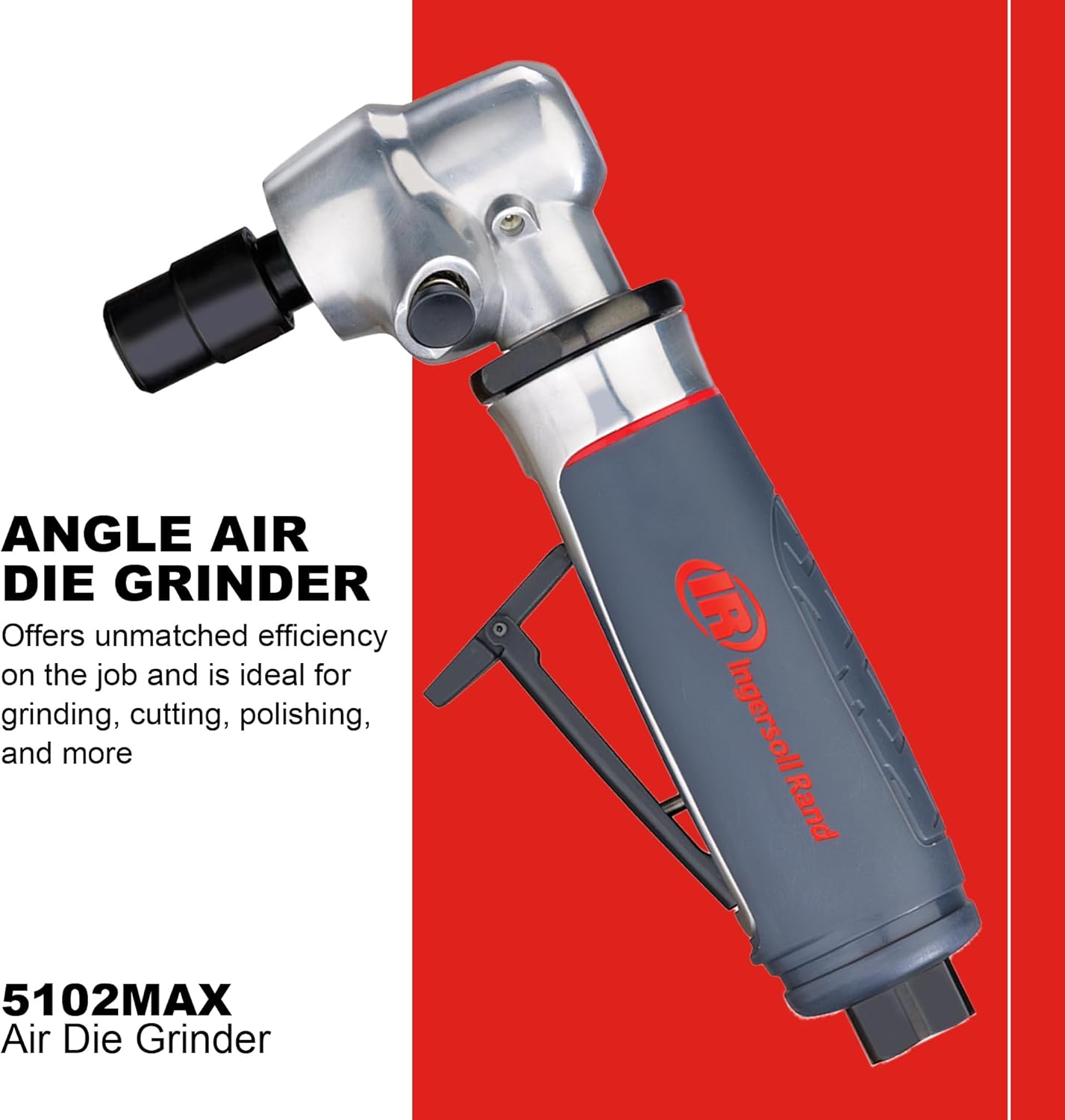
Ingersoll
$129.99
In stock on Amazon
Check price on AmazonRun that table against every brand rep you’re talking to. A rep who can’t answer the rebuild interval question doesn’t know the product well enough to sell it to a production shop.
The Decision Rule
Here’s the if/then frame this article earns:
If you’re running more than one shift, more than one station, or operators who rely on the tool daily — then buy Ingersoll Rand or Dynabrade, size your compressor for peak simultaneous CFM, install in-line oilers, and treat consumable replacement as a scheduled cost, not a surprise. Ingersoll — $129.99
If you have a single station, intermittent use, and a tight tool budget — then the mid-tier option is the honest answer. Pair it with proper air supply and oiling, and it will serve the application without overpaying for features you won’t use. Ingersoll — $90.99
If you’re genuinely occasional — one operator, one project type, a few hours a week — the budget tier is fine, with eyes open about shorter motor life. Ingersoll — $59.99
The die grinder market in 2026 has more options than ever, and the import tier has genuinely improved over the last five years. But the production floor still rewards the brands that publish honest specs, stock parts, and build to tolerances that hold up past the warranty period. Ingersoll Rand didn’t earn its reputation by accident — and when you’re quoting a four-station weld-prep setup where downtime costs real money, that reputation is part of the purchase.